Choosing a loading ramp involves balancing four interacting technical variables: the actual load to be moved, the allowable slope, the material of the ramp, and the type of fastening. Miscalculating any of these exposes you to the risk of tipping, permanent deformation, or injury. This article compares measurable parameters to guide the choice towards the ramp suitable for each use, from construction sites to loading motorcycles onto trailers.
Human effort and maximum slope: the criterion that product sheets overlook
Most selection guides focus on the load capacity in tons and the length of the ramp. They overlook the person who pushes or pulls the load up the slope.
The Labor Code (article R.4541-9) sets clear thresholds for manual handling on inclined planes. According to Espace-Équipement, the starting effort should not exceed 30 daN in horizontal translation, and the effort to maintain movement is limited to 25 daN. These values directly condition the slope and the non-slip surface of the ramp as soon as an operator intervenes with a hand truck, cart, or wheelbarrow.
In practical terms, a short ramp with a slope close to the technical maximum of 30% (about 16.5°) is suitable for a motorized vehicle that ascends on its own. For a manually pushed load, the slope must drop significantly below this threshold to remain within regulatory effort limits.
For accessible ramps, recent recommendations go even further with slopes of around 5 to 10% and a practical ratio of one unit of length for every unit of height in inches (ratio 1:12).
If you compare loading ramps at Brico Dépôt, always check the resulting slope based on the height of your trailer or dock before validating a model.
Comparison table: aluminum, steel, and folding ramps for common uses
The material determines the relationship between self-weight, load capacity, and ease of transport. Here is a summary of the differences according to the most common configurations.
| Criterion | Aluminum Ramp | Steel Ramp | Folding Ramp (aluminum) |
|---|---|---|---|
| Self-weight | Light | Significantly heavier | Light, compact when stored |
| Load capacity | Medium to high | Very high | Moderate |
| Corrosion resistance | High (without treatment) | Requires galvanization or painting | High |
| Typical use | Construction site, trailer, motorcycle | Heavy machinery, construction | Hand truck, mower, wheelchair |
| Transport and storage | Manageable alone | Often requires two people | Utility vehicle trunk |
Aluminum dominates common uses because it offers a good compromise between lightness and robustness without corrosion maintenance. Steel is only justified when the load significantly exceeds what aluminum can support within a reasonable width.
Folding ramps are appealing due to their reduced bulk. However, their capacity remains limited, confining them to light loads or accessibility use.
Oversizing load capacity: safety margin or waste
A common reflex is to choose the ramp whose nominal capacity exactly matches the weight of the load to be lifted. This reasoning ignores two concrete factors.
- The capacity announced by the manufacturer assumes a load evenly distributed over the entire length. As soon as the load concentrates on a single axle (a frequent case when crossing a threshold), the point load can exceed the effective capacity of the ramp.
- The wheelbase of the vehicle plays directly: the shorter the distance between axles, the more the load concentrates. Manufacturer data sheets for ramps often indicate a span based on the wheelbase (distance between front and rear wheels), which decreases as the load concentrates.
- The weight carried in the vehicle (fuel, mounted tools, accessories) adds to the empty weight announced. A riding mower loaded at the end of the day weighs significantly more than the catalog weight.
The operational rule is to choose a ramp whose capacity exceeds the total actual weight of the loaded vehicle by at least one third. This oversizing does not necessarily increase the budget significantly, but it protects the ramp structure against mechanical fatigue with each use.

Fastening and ramp width: two common mistakes on trailers
The type of attachment conditions stability during loading. Two systems coexist: the support shoe (which rests on the edge of the floor) and the fastening by hook or pin (which locks the ramp onto the trailer).
A simple shoe is sufficient on a fixed, flat dock. On a trailer, the hook fastening prevents any lateral slipping during ascent, especially if the vehicle turns slightly. Without locking, the ramp can shift a few centimeters, which is enough for a wheel to miss the ramp.
Minimum width according to wheel type
The width of the ramp must exceed that of the tire or track by at least a few centimeters on each side. A ramp that is too narrow forces the driver to aim perfectly at the axis, which becomes risky on a slope. For tracked vehicles, the usable width of the ramp must cover the entire footprint of the track, or else the ramp may be loaded asymmetrically and deform.
Ramps with side edges reduce the risk of wheel exit, but they impose a sufficient inner width for the vehicle to pass without friction.
Non-slip surface and outdoor usage conditions
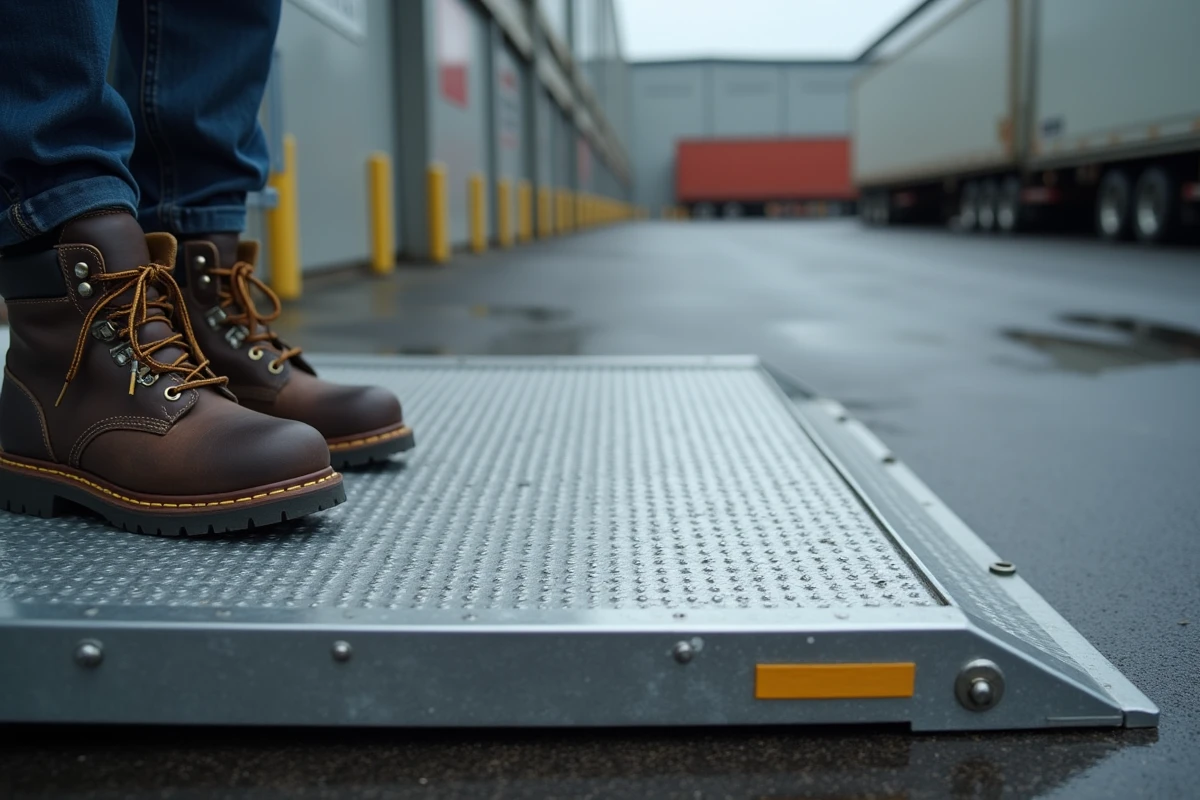
A smooth ramp made of raw aluminum becomes slippery as soon as it is wet, muddy, or greasy. Perforated or gridded surfaces provide better grip and allow water to pass through, which limits aquaplaning for small wheels.
For use on construction sites or in agricultural operations, a striated or pronounced relief surface remains the most reliable choice. Ramps designed for loading motorcycles often incorporate a specific finer surface, suitable for road tires.
The choice of surface thus depends on the actual environment of use, not just the weight of the load. A ramp used exclusively indoors (workshop, garage) can suffice with a less aggressive profile than a ramp exposed to the elements on a construction site.
The sizing of a loading ramp relies on the combination of slope-capacity-fastening-surface, calibrated for the heaviest vehicle and the most unfavorable conditions. Start from the actual loaded weight, not the catalog weight, and check the resulting slope relative to the height of the floor remain the two checks that prevent the majority of loading incidents.