When visiting a Dutch-speaking family, the word you’ll hear most often for grandmother is oma. Two syllables, a gentle sound, and such an established part of everyday life that it has almost eclipsed the official dictionary term. Understanding this word also means understanding how the Netherlands and Dutch-speaking Belgium organize family vocabulary according to register, region, and each household’s habits.
Oma, grootmoeder or bomma: which word to use, and where
You quickly run into a snag when looking up how to say grandmother in Dutch: search results list several terms without explaining which one to use or when. In practice, it comes down to three specific factors.
Grootmoeder is the formal word. You’ll find it in administrative documents, notarial deeds, and legal texts. No one says “grootmoeder” to address their grandmother over dinner. It’s the equivalent of saying “grandmother” in full in English, reserved for official contexts.
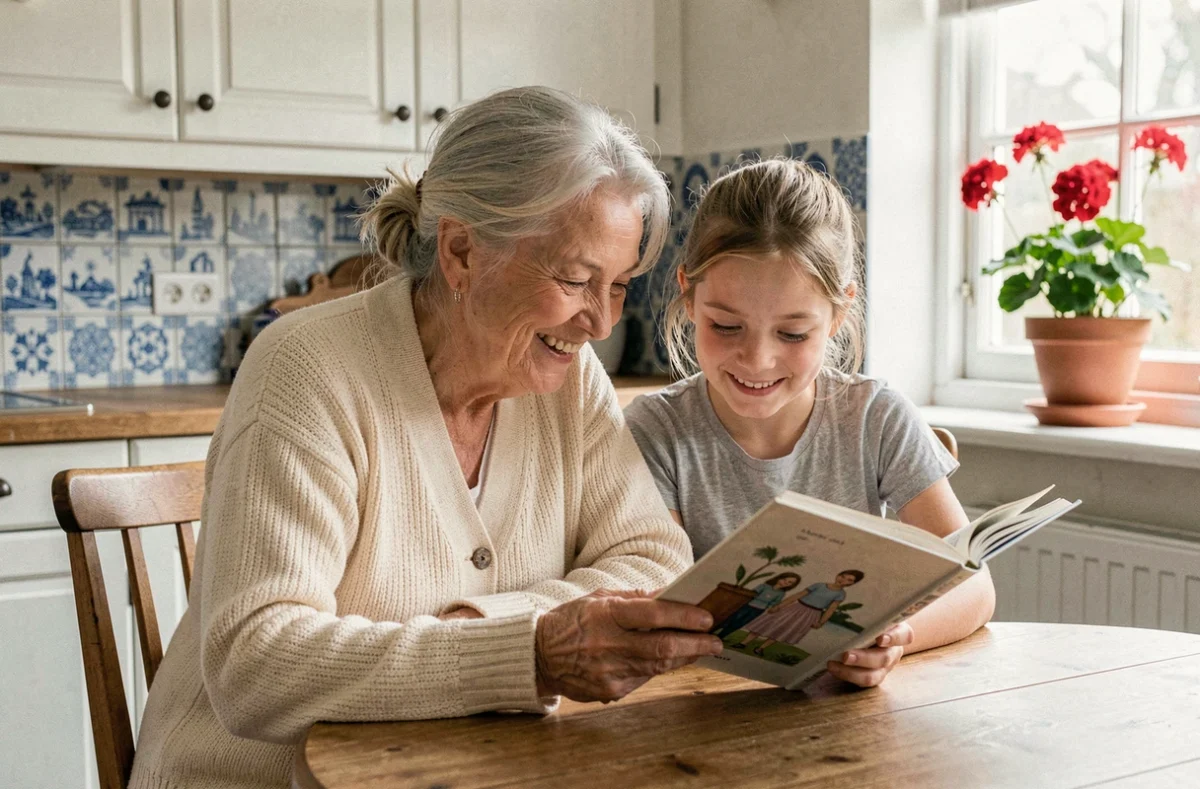
Oma is the standard affectionate term in the Netherlands. It’s the first word children learn, and the one you hear in parks, schools, and family gatherings. It works both as a form of address (“Oma, kom je?”) and as a way to refer to someone (“Mijn oma woont in Utrecht”).
In Dutch-speaking Belgium, a third option comes into play: bomma. This Flemish term is still widely used in Flanders, sometimes alongside oma, depending on the family. It isn’t understood in quite the same way in the Netherlands, where it sounds regional or even unfamiliar.
- In the Netherlands, oma is the default choice in almost every family, regardless of social background.
- In Flanders, bomma and oma coexist. The choice often depends on local family tradition and the province.
- Grootmoeder is generally confined to formal writing and institutional contexts on both sides of the border.
The origin of the Dutch word oma and its links to German
Oma isn’t exclusively Dutch. The word is used in German with exactly the same meaning and affectionate connotations. This connection reflects the fact that both languages belong to the West Germanic language group.
The word derives from a shortened form of grootmoeder, following a common pattern in Germanic languages: long family terms are condensed into simple syllables that young children can pronounce easily. Opa (grandfather) follows the same pattern, derived from grootvader.
You’ll sometimes read that oma’s “tender” origins are linked to a specific affectionate root. Available sources don’t support this theory. The most convincing explanation is phonetic simplification, a process found in many languages (French words such as maman, papa, and nana follow the same pattern).
What’s notable is how widely the word is understood beyond Dutch. A Dutch-speaking child who says oma will be understood in Germany, Austria, and parts of Switzerland. This shared understanding makes the term especially useful for bilingual families or households in border regions.
Pronunciation: the difference between Dutch and German
In Dutch, the “o” in oma is long and closed, similar to the French “ô.” In German, the vowel tends to be more open, depending on the region. The difference is subtle, but noticeable to a trained ear.
In both languages, the stress falls on the first syllable. For English speakers, the pronunciation is straightforward: say “oh-ma,” slightly lengthening the first sound.
Dutch family vocabulary: words related to oma
Knowing oma without the rest of the family vocabulary is like learning “hello” without “thank you.” Here are the terms that come up regularly in family conversations in the Netherlands.
Grandfather is opa, formed on the same pattern as oma. Together, grandparents are grootouders. Grandson is kleinzoon, granddaughter is kleindochter, and the general term for grandchild is kleinkind.
- Vader (father) and moeder (mother) are the standard terms, shortened to pa and ma in informal speech.
- Zoon (son), dochter (daughter), broer (brother), and zus (sister) make up the immediate family.
- Oom (uncle) and tante (the same as in English) complete the extended family.
- For in-laws, the prefix schoon- is added: schoonmoeder (mother-in-law), schoonvader (father-in-law).
The term for great-grandmother is a common question. The official word is overgrootmoeder, but in practice, Dutch families improvise. Some keep using oma for a great-grandmother and add a qualifier (grote oma, oude oma). Others come up with a family-specific nickname, which varies from one household to another without any fixed rule.
Oma in everyday life: more than just a translation
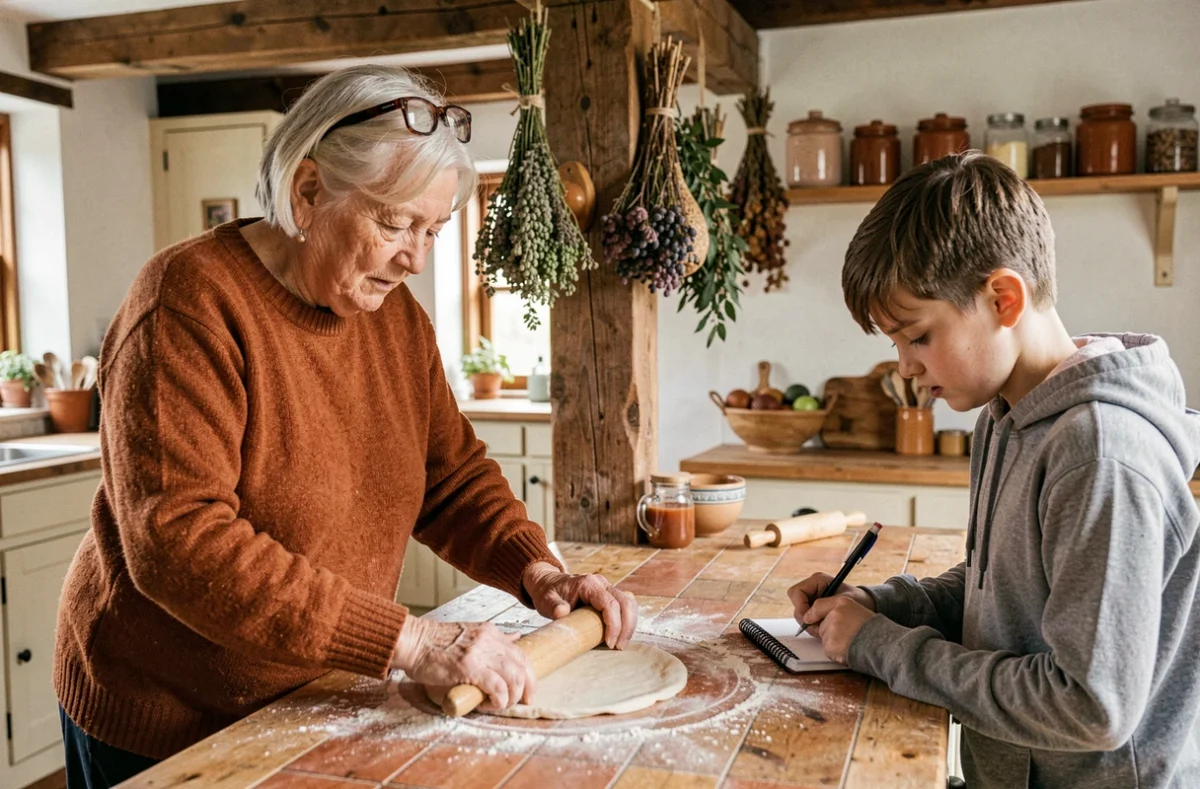
In the Netherlands, oma is more than just a vocabulary word. It’s a cultural marker. People talk about oma-dag (grandmother’s day), when grandparents look after their grandchildren while the parents are at work. This informal childcare arrangement is deeply rooted in Dutch family life.
The word also appears in everyday expressions. Opoe (an older, regional form) can still be heard in some northern provinces. In popular culture, oma evokes a warm image, associated with homemade stroopwafels and afternoons spent playing in the garden.
For French-speaking families living in the Netherlands or Belgium, adopting oma is often the first step toward helping their children integrate linguistically. The word is short, easy to remember, and already used by the children in the neighborhood. Choosing between oma, grootmoeder, and bomma is a matter of register, not translation: all three refer to the same person, but each says something different about the relationship and the context.